Outside the city wall of Jerusalem · Today: Church of the Holy Sepulchre (traditional), Jerusalem
Golgotha in the Bible
Also called Calvary
Golgotha, Aramaic for 'the place of a skull' (Latin Calvaria, hence Calvary), is where Jesus is crucified between two others. All four Gospels name it, and John adds that it was near the city, in a garden with a new tomb. Its exact location is debated between the Church of the Holy Sepulchre and the Garden Tomb.
Geographic context
Golgotha on the map
Golgotha was near Jerusalem, outside the city gate; its exact location is not known. On this map, the traditional location is at the Church of the Holy Sepulchre in today's Old City. The Garden Tomb, north of the Old City, is a later alternative proposal. The Temple Mount is marked to help orient you, not as a proposed site.
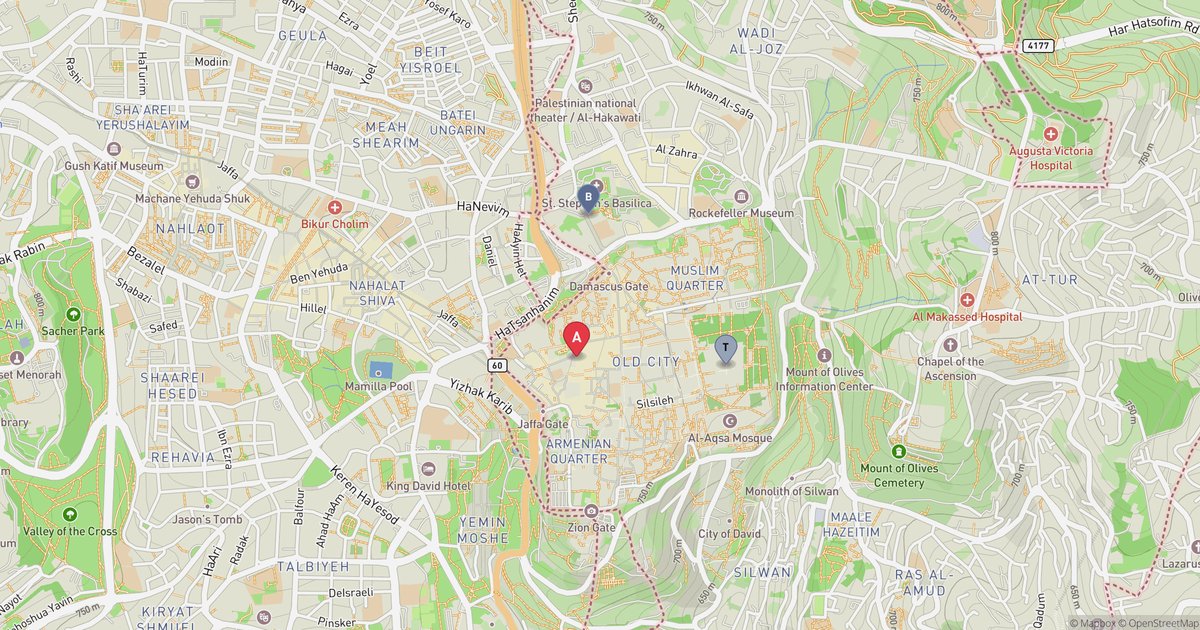
- A · Traditional location
- Church of the Holy Sepulchre. The area lay outside Jerusalem's first-century wall and has rock-cut tombs from that period; its identification dates to the fourth century.
- B · Alternative proposal
- Garden Tomb, north of the Old City. Proposed in the nineteenth century; the tomb there is generally dated earlier than Jesus' time.
Archaeology
The Holy Sepulchre site lay outside the first-century city wall and contains rock-cut tombs of the right period, which is the strongest argument in its favour. The Garden Tomb, north of the Old City near a skull-like rock face, was proposed in the nineteenth century, but its tombs are centuries earlier than Jesus.
Verses mentioning Golgotha
3 occurrences across 3 verses in the King James Version.
- Matthew 27:33
And when they were come unto a place called Golgotha, that is to say, a place of a skull,
Read in context - Mark 15:22
And they bring him unto the place Golgotha, which is, being interpreted, The place of a skull.
Read in context - John 19:17
And he bearing his cross went forth into a place called the place of a skull, which is called in the Hebrew Golgotha:
Read in context